
IPTV vs Cable TV in 2026: Cost, Flexibility, Devices & Internet Requirements
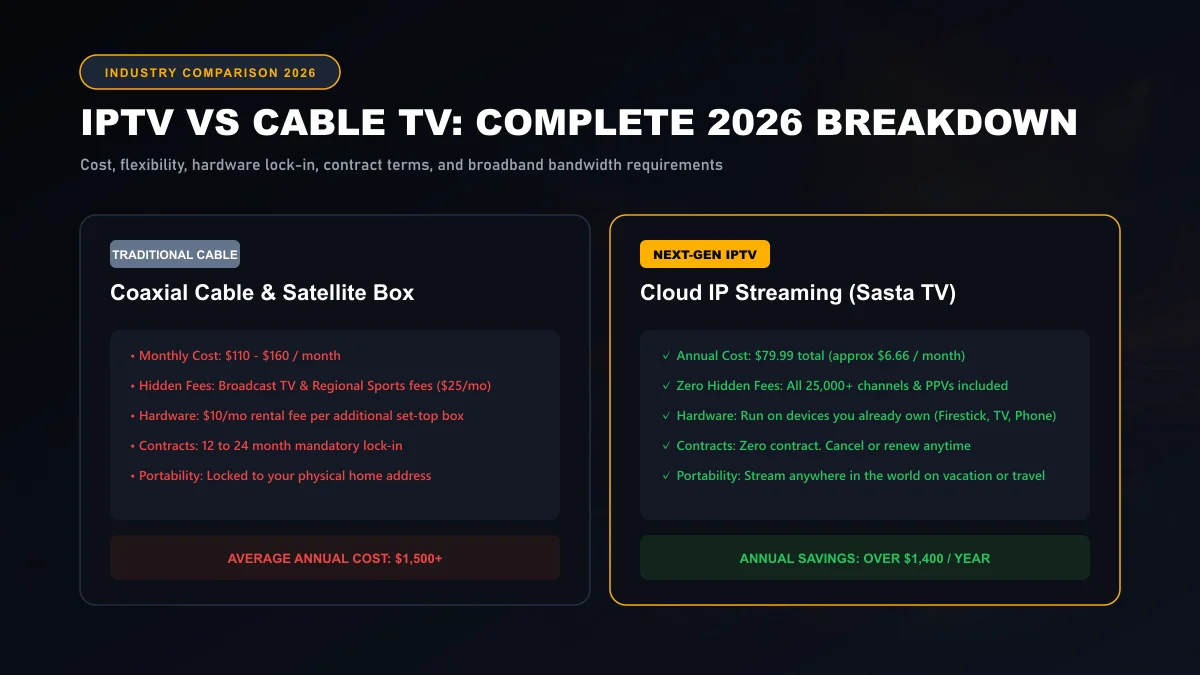
The choice between traditional cable television and modern IPTV in 2026 comes down to three decisive factors: cost, hardware freedom, and portability. While cable TV continues to lock households into long-term contracts, proprietary set-top box rental fees, and localized address restrictions, IPTV delivers thousands of 4K channels, live sports, and VOD across any internet-connected device at a fraction of the cost.
IPTV vs Cable TV at a Glance
To understand why millions of households worldwide are cord-cutting in favor of IPTV, review this high-level side-by-side comparison:
| Comparison Factor | Traditional Cable TV | Modern IPTV (Sasta TV) |
|---|---|---|
| Average Monthly Cost | $110 – $160 / month | $6.66 / mo ($79.99/year) |
| Hardware Requirements | Leased proprietary box ($10–$15/mo per TV) | Devices you already own (Firestick, TV, Phone) |
| Contract Commitments | 12 to 24 month mandatory lock-in | Zero contracts. Cancel or renew anytime |
| Channel & Content Variety | 150 – 300 regional channels | 25,000+ Global Channels + 120,000+ VOD |
| Pay-Per-View (PPV) Events | $75 – $90 extra per individual fight | Included at zero additional surcharge |
| Portability | Tied strictly to physical residence | Watch anywhere in the world on vacation/travel |
| Installation | Coaxial cable, wall drilling, technician visit | Instant 5-minute app download |
How IPTV Works: IP Packet Delivery
IPTV (Internet Protocol Television) operates by digitizing, compressing, and transmitting video content in discrete TCP/IP or UDP data packets over standard broadband networks. When you switch to a channel, your device requests that specific stream from a content delivery network (CDN) server.
Because only the channel you are actively watching is transmitted to your device, network bandwidth is utilized with maximum efficiency. Modern video codecs like H.265 (HEVC) allow transmitting crisp 4K Ultra HD video at 60 FPS using just 20 to 25 Mbps of internet throughput.
Learn more about packet-switched communication on Cloudflare Network Protocol Guides .
How Cable TV Works: Coaxial & RF QAM
Traditional cable television relies on hybrid fiber-coaxial (HFC) networks. An operator broadcasts hundreds of television channels simultaneously across physical copper cables using radio frequency quadrature amplitude modulation (QAM).
Because all 200+ channels are constantly fed into your home wire at the same time, available cable bandwidth is strictly constrained. To squeeze hundreds of channels into one physical wire, cable operators aggressively compress video streams (frequently downsampling to interlaced 1080i or 720p). Official regulatory frameworks are documented by the FCC Cable Television Service Rules .
Installation Differences & Hardware Requirements
The physical friction involved in setting up cable television is one of its greatest drawbacks:
Cable TV Installation
- Requires scheduling a technician home appointment.
- Drilling holes through exterior masonry for coaxial lines.
- Leased set-top decoder boxes generating perpetual rental fees.
- Additional proprietary remotes and power bricks cluttering your TV stand.
Sasta TV IPTV Installation
- 100% digital self-setup completed in 5 to 10 minutes.
- Zero drilling, dishes, or specialized hardware required.
- Runs directly on your Amazon Firestick, Smart TV, or mobile device.
- Step-by-step guidance available in our setup tutorials.
Device Flexibility & True Anywhere Portability
In a modern household, television is no longer confined to the living room sofa. We consume live sports, news, and entertainment across tablets, smartphones, and bedroom displays.
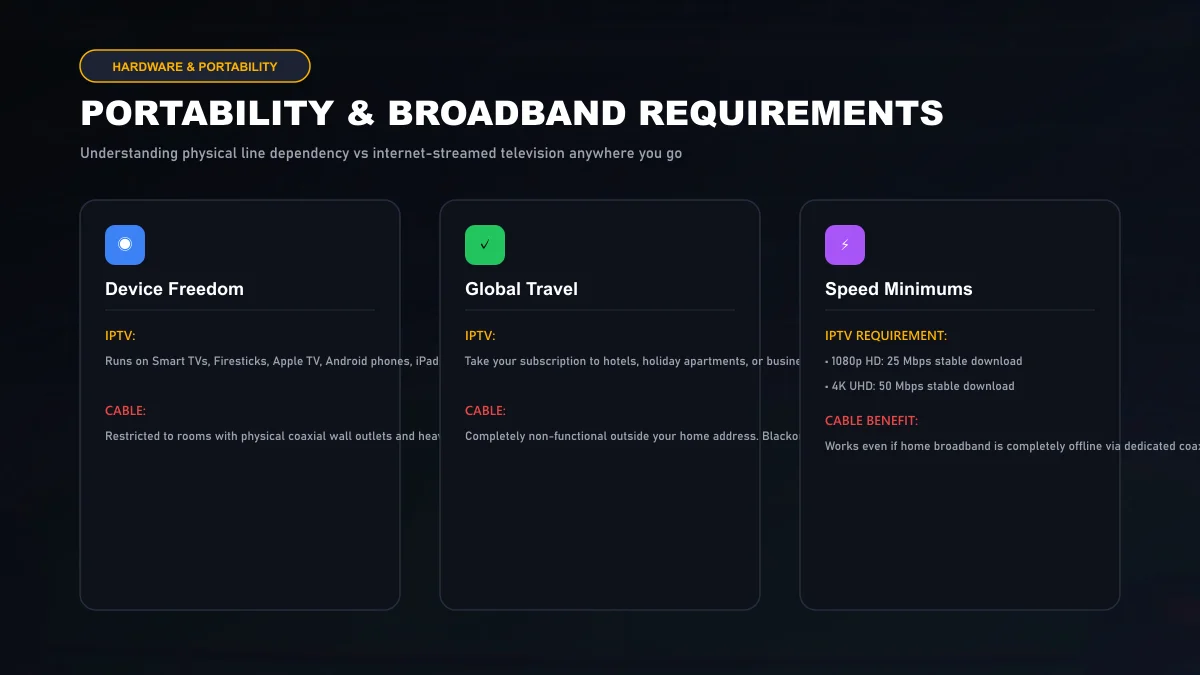
Cable TV is strictly geolocked to your physical street address. If you travel for work, rent a vacation home, or want to catch a match on your lunch break, your home cable subscription is completely inaccessible.
With Sasta TV, your subscription travels in your pocket. You can stream 4K Premier League football from a hotel room in Paris, a business trip in New York, or an airport lounge using your smartphone, tablet, or a portable Fire TV Stick.
Internet Dependency: Broadband vs Dedicated Wire
To maintain an objective, fair comparison, it is critical to acknowledge cable television's single genuine operational advantage: independence from broadband bandwidth.
Because cable TV signals travel across dedicated RF frequencies, you can watch television even if your home broadband internet is experiencing an outage.
Conversely, IPTV depends entirely on an active internet connection. For smooth buffer-free viewing, your home network must deliver:
- 1080p Full HD: Minimum 20 to 25 Mbps stable download speed.
- 4K Ultra HD (60 FPS): Minimum 40 to 50 Mbps stable download speed.
- Low Jitter: Ping jitter under 5ms to prevent video buffer exhaustion.
Picture Quality: Bitrates, Codecs & 4K Comparison
A common myth is that cable TV offers superior picture quality to internet streaming. In 2026, the exact opposite is true.
Due to frequency bandwidth congestion, legacy cable operators transcode live video into low-bitrate MPEG-2 or basic H.264 streams, frequently capping resolution at 720p or 1080i at 30 FPS.
Sasta TV utilizes modern HEVC / H.265 video compression protocols outlined in Apple Developer HTTP Live Streaming Specifications . This delivers progressive 1080p and 4K Ultra HD resolution with high-bitrate audio and genuine 60 FPS motion pacing.
Cost Structure & Hidden Cable Fees Audit
The financial contrast between cable and IPTV is staggering once you audit hidden equipment charges, sports surcharges, and annual contracts.
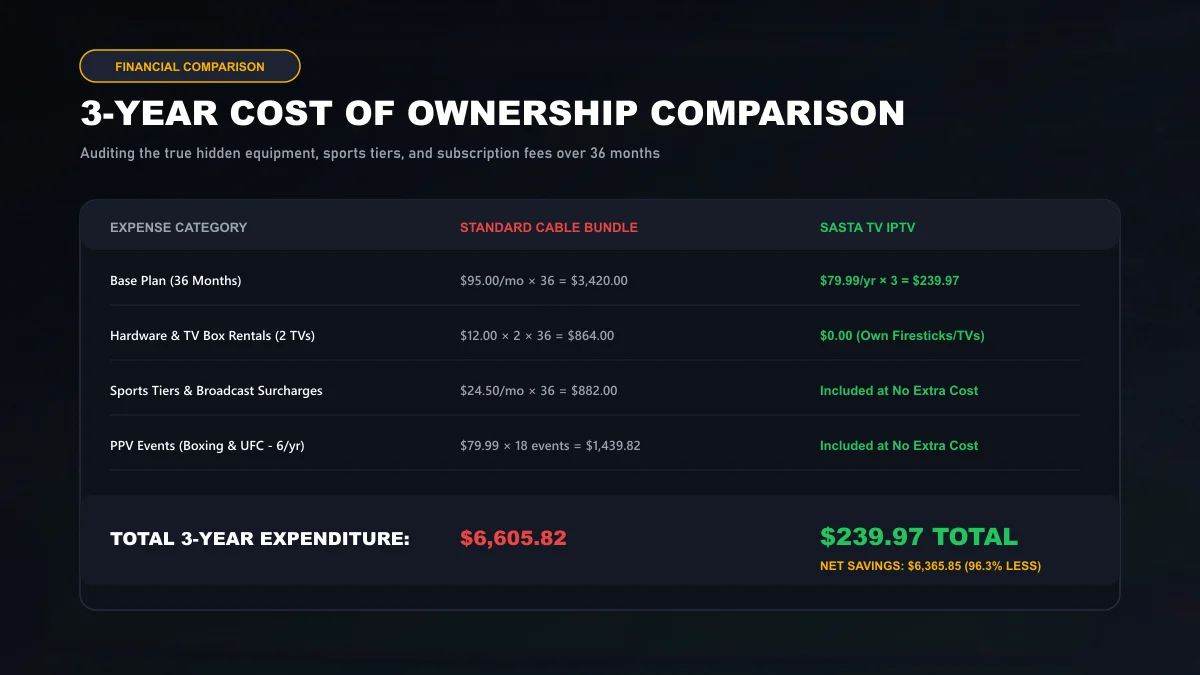
Over a 3-year span, an average cable customer paying $130/month plus two TV box rentals and sports fees spends over $6,600. In contrast, three full years of Sasta TV costs just $239.97 total—saving over 96% while delivering ten times more content.
Review our completely transparent pricing with zero hidden surcharges on our Sasta TV pricing plans, backed by an unconditional 7-day money-back guarantee.
Reliability: Weather Outages vs Server Uptime
Satellite TV and aerial cable often suffer from severe rain fade, wind displacement, or local utility pole knockdowns during storms.
Sasta TV operates from enterprise European data centers with 99.9% verified uptime and multi-edge Anycast CDN failover redundancy. If an uplink transponder experiences localized weather interference, traffic is re-routed within seconds to redundant backup feeds.
Read our in-depth technical analysis in the Sasta TV review and feature breakdown.
Who IPTV Suits vs Who Cable Suits
To make your final decision, determine which profile matches your household:
Who IPTV Perfectly Suits
- Households with stable 25+ Mbps broadband.
- Sports fans wanting 60 FPS feeds and zero-cost PPVs.
- Viewers who watch on Firesticks, Smart TVs, or mobile devices.
- Consumers tired of paying $100+/month for TV.
- Expats wanting international channels from UK, US, CA, and Europe.
Who Cable May Still Suit
- Rural homes with DSL internet speeds under 10 Mbps.
- Users uncomfortable with basic app downloads.
- Homes in areas with frequent broadband outages.
Have questions about switching from cable to IPTV? Connect with our team 24/7 on Sasta TV customer support.
Industry Comparison Frequently Asked Questions
What is the single biggest financial difference between cable and IPTV?
Cable TV involves massive recurring equipment rentals ($10-$15/month per TV box), mandatory regional sports surcharges ($20-$30/month), and contractual termination penalties. Over 3 years, a standard cable package exceeds $5,000 to $6,500. Sasta TV provides all channels, sports, and PPV on devices you already own for $79.99/year—saving over 95% total cost.
Can I watch IPTV if my home broadband internet goes down?
No. IPTV requires an active internet connection to download streaming packets. Traditional cable television operates over a dedicated physical radio frequency (RF) coaxial pipe and functions even during broadband outages (though not during local power grid failures).
Is IPTV picture quality as good as traditional cable TV?
In 2026, premium IPTV providers using modern H.265/HEVC encoding frequently surpass legacy cable. Traditional cable operators aggressively compress 1080i signals to conserve coaxial bandwidth. High-end IPTV delivers pristine 1080p and 4K Ultra HD at 50/60 FPS with uncompromised bitrates.
Do I need a technician to come install cables in my walls for IPTV?
No. IPTV requires zero physical installation, wall drilling, satellite dishes, or technician appointments. You simply download an app onto your Firestick, Smart TV, or phone, enter your credentials, and start streaming within minutes.
Can I take my IPTV subscription with me when I travel abroad?
Yes. Because IPTV operates over any secure internet connection, you can log in from hotels, vacation rentals, airports, or friends' houses anywhere in the world. Cable subscriptions are strictly geolocked to your residential physical wall jack.
Are there long-term contracts with Sasta TV IPTV?
None. Unlike cable operators that enforce 12 to 24-month binding contracts with early termination penalties, Sasta TV offers flexible 1, 3, 6, and 12-month plans with a 7-day money-back guarantee and zero contractual commitments.